
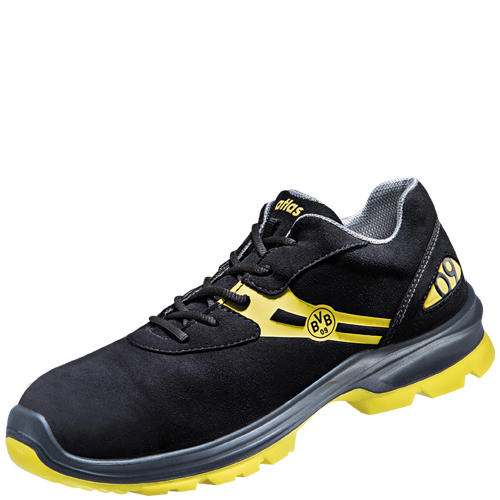
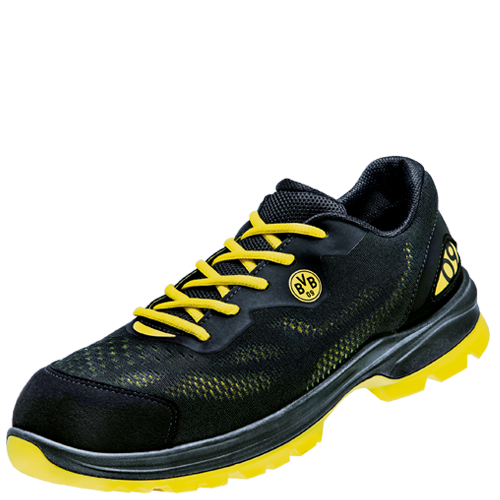

ATLAS Malocher 09: Real Work – Real Protection
When passion meets safety: the official BVB Safety Edition.
Where hard work, sweat and integrity matter, you need kit that won’t let you down. The ATLAS Malocher 09 range is more than just a work boot – it’s a statement. Developed in collaboration with Borussia Dortmund, this range combines the ruggedness of the Ruhr region with state-of-the-art safety technology.
Designed for professionals in construction, logistics and industry who want to show their colours even whilst at work. Two well-designed models – the agile low-top shoe and the supportive boot – cover all your needs without you having to compromise on safety, comfort or your love for the club.
A boot with character
At the heart of the range lies the unbeatable combination of durable waterproof leather and tried-and-tested ATLAS technology. Whilst ordinary work boots are often merely a means to an end, the Malocher 09 is a statement of identity. The BVB logo on the tongue and the black and yellow accents make it clear: this isn’t just a job – this is hard graft.

Made for the outdoors
What does this mean for you in practice? The Malocher 09 models are fitted with special outdoor sole technology. The deep-tread pattern literally grips uneven surfaces, mud or gravel, ensuring stability when it matters most. The high-quality leather is naturally robust against mechanical wear and tear and withstands the harsh conditions on a building site.
Easy to care for and durable
Leather is a natural product synonymous with durability. The Malocher 09 shoes are designed to be easy to clean. Coarse dirt can be easily removed thanks to the smooth leather and the self-cleaning sole structure. A shoe that looks just as down-to-earth as you do after a hard day’s work.
The right choice for every fan and professional
The Malocher 09 range offers a clear selection to suit different preferences. Both models share the same premium safety features but differ in design – so you can choose exactly the right shoe for your job.
Low-top: Sportiness meets safety – ATLAS Malocher 09 Low S3
The Malocher 09 Low brings the dynamism of the playing field to the workplace. It offers maximum freedom of movement at the ankle and is ideal for tasks requiring flexibility – whether kneeling, frequently getting on and off machinery, or covering long distances in logistics. It combines the sporty look of a trainer with the uncompromising S3 safety of a work boot.

Boots: Maximum stability – ATLAS Malocher 09 High S3
Anyone working in civil engineering, landscaping or on rough terrain needs extra support. The ankle-high Malocher 09 High offers enhanced protection against twisting and provides optimum stability for the foot. The padded tongue and cuff ensure that there’s no pressure, even when the laces are tightly fastened. It’s a fortress for your feet when conditions outside get tough.

Who is the Malocher 09 range ideal for?
Construction & trades: The Malocher 09 is right at home on the building site. Its S3 specification protects against wet conditions and hazards, whilst the tread keeps you steady on ladders and scaffolding. The durability of the leather withstands rough handling of building materials.
Logistics & Warehousing: Here, the low-top boot really stands out thanks to its sporty design and alu-tec lightness. Anyone who walks many kilometres a day will benefit from the excellent cushioning and the BVB style, which still looks good even after work.
BVB Fans & Local Pride: For everyone who wears black and yellow in their hearts. Show your loyalty at work too. This shoe makes a statement of ‘true love’ for the club and for hard work.


FAQs
Do Atlas shoes tend to run small or large?
Compared to many sports shoes, Atlas safety shoes tend to run slightly larger for some customers, which means these customers need to go one size smaller in Atlas shoes. However, the most accurate and easiest way to determine the exact size of Atlas safety shoes is via the ‘Scan your Feet’ app or by measuring your feet. You can find further information in our size guide.
WHAT IS THE DIFFERENCE BETWEEN SAFETY CLASSES S1 AND S3?
WHEN DO I NEED S3 SAFETY FOOTWEAR?
How long do safety low-top shoes last on average?
Which safety class for which occupation?
S1/S1P: Warehousing, logistics, light assembly
S2: Kitchens, cleaning, food
S3: Construction, skilled trades, outdoor assembly, agriculture
The employers’ liability insurance association provides sector-specific recommendations.