
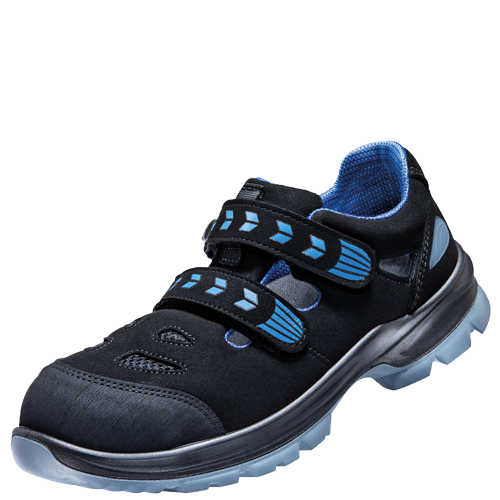


O1 Work Footwear: Reliable protection without a toe cap
Not every workplace requires traditional safety footwear with a toe cap. Where a risk assessment does not require impact protection, O1 work shoes offer the ideal solution: they meet key safety requirements in accordance with the European standard EN ISO 20347:2022 whilst also offering a high level of comfort.

Overview: What does the O1 classification entail?
O1 work shoes are based on the basic requirements for work footwear – work shoes without a toe cap that can be worn wherever safety footwear is not required – whilst also meeting a number of additional criteria:
- No toe cap: O1 footwear is work footwear without a toe cap. It is covered by the EN ISO 20347 standard, not EN ISO 20345 (safety footwear).
- Closed heel: The shoe must have a fully enclosed heel.
- Antistatic properties (A): The sole dissipates electrostatic charges in a controlled manner, thereby protecting against dangerous sparking.
- Energy absorption in the heel area (E): The heel absorbs impact energy, thereby protecting the joints and spine.
- Resistance to hydrocarbons (FO): The outsole is resistant to swelling caused by fuels, oils and diesel.
- Slip-resistant outsole: A basic requirement for all work shoes in accordance with EN ISO 20347, tested on ceramic tiles with cleaning agents to ensure a secure grip.
What sets O1 work shoes apart?
As work footwear compliant with the EN ISO 20347:2022 standard, they offer tested and certified basic protection specifically designed for workplaces where no risk of impact to the toe area has been identified. The antistatic properties protect environments where electrostatic discharges could damage sensitive equipment or generate ignition sparks, such as in electronics manufacturing, cleanrooms or food processing.
At the same time, the energy absorption capacity in the heel area reduces mechanical stress during prolonged standing and walking, which is particularly valuable for occupational groups with a high walking frequency or long periods of standing. The hydrocarbon-resistant outsole also protects against swelling caused by oils and fuels – a crucial advantage in industrial environments where floor contamination is a regular occurrence. As O1 shoes are manufactured without a toe cap, they often offer a more natural toe box design and are lighter than comparable S-class footwear.
Are O1 work shoes the right choice for you?
The specifications and protection you need from your safety footwear depend entirely on the requirements and hazards of your working environment.
If O1 work shoes are the right choice for you, this usually means that your workplace is as follows:
- Dry, indoors and on level floors.
- There are hardly any sharp objects such as nails, screws, glass or metal splinters that you might potentially step on.
- Your shoes do not need to be waterproof.
However, if your environment and safety requirements do not match these specifications, you may need to choose a different safety class.
- If your workplace is outdoors, on damp ground or in changing conditions: look for safety classes O2 or S3, or S7 in extreme conditions.
- If there are regularly sharp objects on the ground and you need puncture protection: look for safety classes S1, S3 and S7.
- If your environment is wet or damp and your footwear needs to be water-repellent: you’ll need shoes that offer either WPA or WR. You can find out more about the difference here. These are usually shoes in safety classes S3, S5 and S7.
This table also provides you with a quick overview of the specifications of O1 occupational shoes and similar safety classes.
If you’re still unsure, we recommend using our Shoefinder, which will help you find the right shoe to suit your specific needs.
Find Your Match
Who are O1 work shoes suitable for?
O1 footwear is not suitable for every workplace, and that is precisely where its strength lies: it is specifically designed for working environments with a low to medium risk of mechanical hazards. If you work in an environment where impact resistance is important, such as on construction sites or in the trades, you should look for safety footwear compliant with standards S1 to S7, depending on your needs. Typical occupational fields and areas of use for O1 work shoes include:
- Catering and hospitality: kitchen staff and service personnel who work on non-slip floors and require high levels of comfort for long shifts.
- Healthcare and nursing: Care workers and medical staff for whom antistatic properties and ergonomics are paramount.
- Electronics manufacturing and cleanrooms: Areas with increased ESD sensitivity where toe caps are not required, but antistatic properties are essential.
- Retail and logistics (light-duty work): Office staff and warehouse workers who do not handle heavy loads or falling objects can wear work shoes. However, S1 footwear such as our Runner, Fast or Flash ranges is often the more suitable choice and offers a wider selection.
- Office and administrative roles in industrial environments: People who occasionally enter production areas but are not exposed to direct mechanical hazards. City-style shoes may also be a suitable choice here, particularly if a more professional look is desired.
