


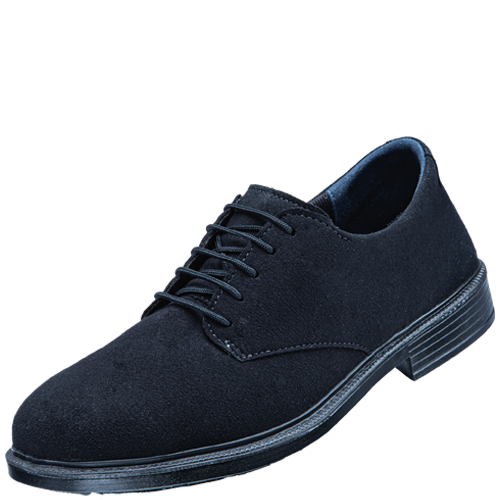
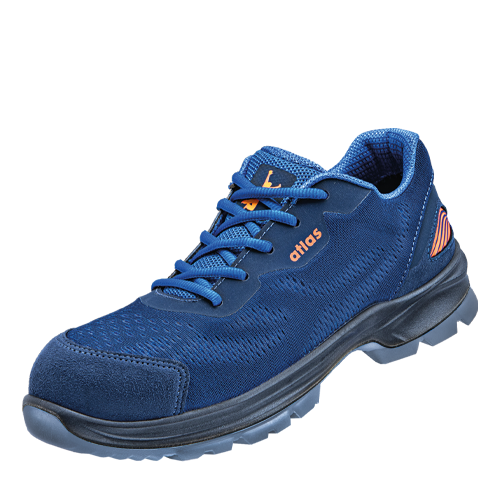

S1 safety footwear: protection and comfort for your everyday working life
S1 safety footwear is the core category for indoor work environments. In accordance with the current EN ISO 20345:2022 standards, these models combine essential protective features with a high level of comfort and are ideal for indoor use where there are no extreme external stresses.

Key protective features of S1 safety shoes:
- Toe cap (metal, aluminium or plastic): Reliable protection against impact and pressure (up to 200 joules).
- Closed heel area and energy absorption (E): Reduces strain on joints and the spine during long shifts.
- Antistatic properties (A): Reduces electrostatic build-up – crucial in sensitive technical environments.
- Optimised slip resistance (SR): Basic slip resistance is now mandatory under the new standards; the SR marking also indicates a secure footing on smooth or oil-contaminated floors.
- New puncture-resistant classes: S1 footwear can now be classified as S1P (steel), S1PL (textile, 4.5 mm test nail) or S1PS (textile, 3.0 mm test nail) to provide targeted protection against punctures.
- Fuel resistance (FO): Now an optional additional requirement offering specialised protection in workshops and logistics areas.
What makes S1 safety footwear stand out?
As footwear compliant with the EN ISO 20345:2022 standard, S1 shoes offer tested and certified basic protection, specifically designed for workplaces where there is a risk of impact injuries to the toes, but where the environment remains predominantly dry. The protective toe cap reliably protects your feet from falling or rolling objects, which is a crucial advantage in production, assembly and warehouse environments, as these hazards are part of everyday working life there.
At the same time, the energy absorption in the heel area specifically reduces mechanical stress during prolonged standing and walking. This is particularly important for occupations involving a high walking rate or long periods of standing, such as in logistics or assembly work. Certain S1 models also feature ESD protection, which safeguards the wearer in environments where electrostatic discharges pose a risk. The outsoles of the ATLAS S1 models are also designed to protect against degradation caused by oils and fuels – a key advantage in industrial environments where floor contamination is common. As S1 footwear is manufactured without additional waterproof or puncture-resistant components, it is often lighter and more breathable than comparable S3 or S7 footwear.
Are S1 safety shoes the right choice for you?
The specifications and protection you need from your safety shoes depend entirely on the requirements and hazards of your working environment.
If S1 safety shoes are the right choice for you, your workplace will generally be as follows:
- Dry, indoors and on level floors.
- There is a risk of falling or rolling objects that could injure your toes.
- There are hardly any sharp objects such as nails, screws, glass or metal splinters that you might accidentally step on.
- Your shoes do not need to protect against water ingress.
- If your workplace is outdoors, on damp ground or in changing conditions: look for safety classes S2 or S3, or S7 in extreme conditions.
- If there are regularly sharp objects on the ground and you need puncture protection: look for safety classes S1P, S1PL, S1PS, S3 and S7.
- If your environment is wet or damp and your footwear needs to be water-repellent: you’ll need shoes that offer either WPA or WR. You can find out more about the difference here. These are usually shoes in safety classes S3, S5 and S7.
- If no impact protection in the toe area is required: a work shoe in class O1 or O2 may be the lighter and more comfortable alternative.
The table below also provides you with a quick overview of the specifications of S1 safety shoes and similar safety classes.
If you’re still unsure, we recommend using our Shoefinder, which will help you find the right shoe to suit your specific needs.
Find Your Match

Who are S1 safety shoes suitable for?
S1 footwear is not suitable for every workplace, and that is precisely its strength: it is specifically designed for dry indoor working environments where there is a risk of mechanical impact to the toes. If you work in an environment where moisture, wet conditions or sharp objects are a factor – for example, on building sites or outdoors – you should instead look for safety footwear in classes S2 to S7, depending on your needs. Typical occupational fields and areas of use for S1 safety footwear include:
- Industrial manufacturing and assembly: Employees in production halls who require protection from falling workpieces or tools, but who mainly work on dry floors.
- Warehousing and logistics: Order pickers and warehouse staff who move light to medium loads in dry warehouses and require reliable toe protection. Our Runner, Fast and Flash ranges offer a wide selection of lightweight and comfortable models for this purpose.
- Automotive and supplier industry: Staff in workshops and on production lines who require protection against mechanical impacts without compromising on comfort or low weight.
- Electronics manufacturing and cleanrooms: Areas with heightened ESD sensitivity, where impact protection is required and antistatic properties are essential.
- Indoor workshops and maintenance: Mechanics and service technicians who handle tools and components but are not regularly exposed to wet conditions or sharp objects.
- Light indoor trades: Activities such as electrical installation, furniture assembly or drywall fitting, where toe protection is advisable but neither puncture resistance nor water resistance is required. For tasks involving sharp objects, footwear in classes S1P, S1PL or S1PS is recommended instead.
ATLAS S1 Safety Footwear – Quality Meets Comfort
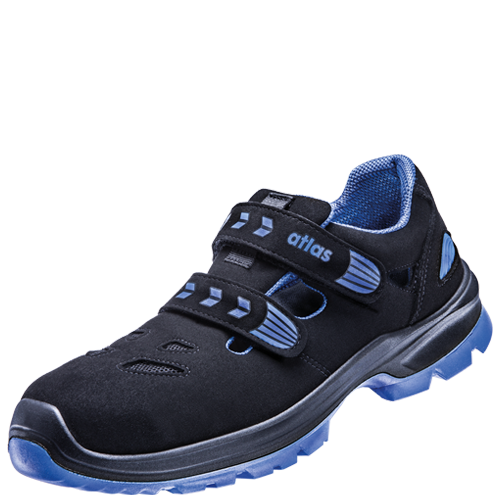
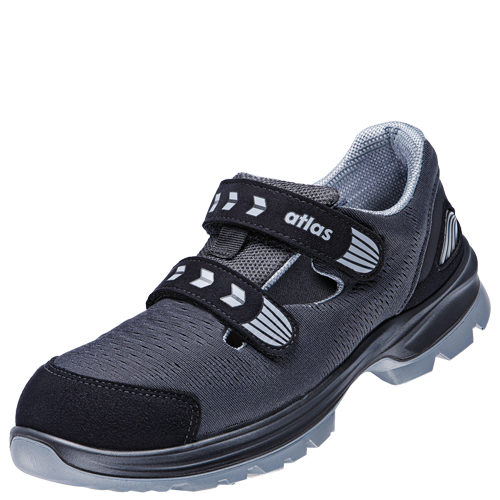
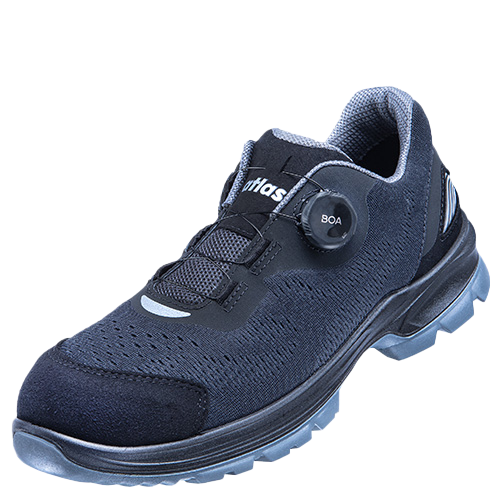
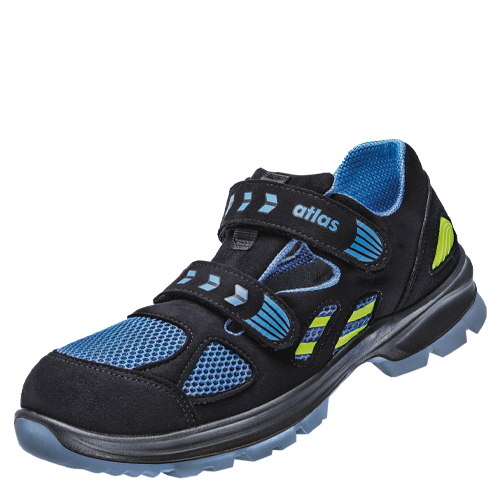
ATLAS offers a wide selection of S1 models in various styles: from a sporty trainer look to a sturdy sandal, available in a range of sizes and widths. Key benefits of the ATLAS S1 models:
- Lightweight & breathable: materials such as mesh ensure a comfortable foot environment, even when worn for long periods.
- Diverse designs: trainer style (RUNNER), urban CITY STYLE, as well as Velcro, lace-up and BOA fastening options.
- ESD features: Protection against electrostatic discharge, ideal for technical environments.
- Robust soles: Fuel-resistant, slip-resistant and shock-absorbing – for maximum safety in everyday use.

FAQ – S1 Safety Footwear
Do Atlas shoes tend to run small or large?
Compared to many sports shoes, Atlas safety shoes tend to run slightly larger for some customers, which means these customers need to go one size smaller in Atlas shoes. However, the most accurate and easiest way to determine the exact size of Atlas safety shoes is via the ‘Scan your Feet’ app or by measuring your feet. You can find further information in our size guide.
How can I find out my shoe size for Atlas safety shoes?
You can determine the right size for your Atlas safety shoes quickly and easily – either directly via the Atlas ‘Scan your Feet’ app or by measuring your feet manually. Both methods ensure that you find the perfect fit for maximum comfort and protection. You can find further information in our size guide.
How can I find out the width of my Atlas shoes?
The best way to determine the ideal width for your Atlas safety shoes is using the Mondopoint method. This internationally recognised measurement method takes into account not only the length but also the width of the foot to ensure the best possible fit.
To determine the correct width, the circumference of the foot is measured at the widest point of the ball of the foot. Based on these measurements, the appropriate shoe width can then be determined using the Mondopoint system.