Shoe widths for safety footwear: How to find the right width
Shoe width simply describes the amount of space available in the front of the shoe – more specifically, around the ball of the foot, the widest part of your foot. Together with shoe length, it forms the most important basis for ensuring a perfect fit for your shoes. Knowing your shoe width is of the utmost importance, particularly when it comes to safety footwear. Whilst standards such as EN ISO 20345 ensure protection against external impacts, choosing the correct size and width protects against internal stress factors caused by ill-fitting shoes – such as pressure sores, heel pain and bunions. A safety shoe can only fulfil its protective function optimally and prevent these health issues if it is tailored precisely to your individual foot.
Go directly to:
What is shoe width?
Shoe width is defined by the internal circumference and volume of a shoe in the forefoot area, specifically at the widest point of the foot (the so-called ball of the foot). Essentially, it indicates how much space the shoe provides for the front part of your foot. As the human foot is a complex structure that significantly changes its shape, volume and width under load, it can be a painful mistake to rely solely on shoe size when buying shoes – particularly safety footwear.
When you take a step and put weight on your foot, the arches flatten and the ball of the foot expands like a natural shock absorber. This expansion enables your foot to safely cushion the impact and distribute your body weight evenly across the ground. Whilst the upper material of conventional shoes can stretch slightly to accommodate this expansion, safety footwear presents a particular challenge.
By definition, particularly from safety class S3 onwards, safety footwear must be fitted with a toe cap made of steel, Alu-tec or composite materials. This toe cap is designed as a rigid safety element and cannot expand. The cap must therefore fit perfectly and must not pinch, squeeze or cause pain at any point. By using a multi-width system, we ensure that the lasts and toe caps of Atlas safety footwear are specifically manufactured to accommodate different foot widths and to guarantee the comfort and well-being of every individual wearer.
How do the different widths differ?
ATLAS uses a multi-width system with four main widths: W10, W12, W13 and W14. In this specialised multi-width system, we do not simply widen the insole and the sole of the shoe. Instead, for widths W12, W13 and W14, the entire last design is modified: in addition to a wider insole, the instep volume is increased and the toe cap is widened. This ensures an all-round comfortable fit for the safety shoe in every width.
- W10 (normal width / standard): Width W10 is the standard width in which all ATLAS safety footwear is manufactured. It is best suited to anatomically normal feet and is designed to fit the foot comfortably, with a slightly wider cut than conventional street shoes. It therefore meets the basic requirements of occupational safety and allows for natural toe spread.
- W12 (Wide): This width is specially designed for sturdy to wide feet. It offers a significantly wider toe cap and noticeably greater internal volume. The circumference is considerably more generous to prevent lateral pressure points on the forefoot.
- W13 (Extra Wide) and W14 (Special Width): These special widths offer the maximum amount of space for safety footwear within our ATLAS multi-width system. The W13 is intended for extra-wide feet where the W12 might still feel too tight. The W14 width was developed for extremely wide and very sturdy feet. These models feature an extra-wide toe cap, an extremely wide ball area and a particularly large instep volume (instep height). They are ideal for wearers with pronounced flat feet or fallen arches, for whom standard or even medium-width toe caps would immediately cause discomfort on the top and sides of the feet.


Although W10 is the standard size and is suitable for most foot types, if you experience pressure points or discomfort on the sides or on the ball of your foot, you should check whether a W12, W13 or W14 would be a better fit for you. Below you will find our size and width chart. This shows which shoe size and width correspond to the length and width of a foot in millimetres.
| Größe | Länge in mm | Weite 10 | Weite 12 | Weite 13 | Weite 14 |
|---|---|---|---|---|---|
| 35 | 211–217 | 80–94 | 95–97 | 98–103 | 104–200 |
| 36 | 218–225 | 82–96 | 97–99 | 100–105 | 106–200 |
| 37 | 226–232 | 84–98 | 99–101 | 102–107 | 108–200 |
| 38 | 233–240 | 87–101 | 102–103 | 104–109 | 110–200 |
| 39 | 241–247 | 89–103 | 104–105 | 106–111 | 112–200 |
| 40 | 248–253 | 91–105 | 106–108 | 109–114 | 115–200 |
| 41 | 254–259 | 93–107 | 108–110 | 111–116 | 117–200 |
| 42 | 260–267 | 95–109 | 110–112 | 113–118 | 119–200 |
| 43 | 268–274 | 97–111 | 112–114 | 115–120 | 121–200 |
| 44 | 275–282 | 99–113 | 114–116 | 117–122 | 123–200 |
| 45 | 283–289 | 101–115 | 116–118 | 119–124 | 125–200 |
| 46 | 290–297 | 104–118 | 119–120 | 121–126 | 127–200 |
| 47 | 298–304 | 106–120 | 121–123 | 124–129 | 130–200 |
| 48 | 305–312 | 108–122 | 123–125 | 126–131 | 132–200 |
| 49 | 313–319 | 110–124 | 125–127 | 128–133 | 134–200 |
Why is shoe width so important for safety footwear?
For tradespeople, industrial workers and skilled workers in logistics and construction, the day-to-day demands of the job present an immense physical and cognitive challenge. Safety footwear is not only crucial for your safety in the workplace. As it is worn continuously during 8- to 10-hour working days, it is essential that it provides optimal support and a comfortable fit to safeguard your long-term health.
The shoe width is of critical importance in safety footwear for several biomechanical, health and safety-related reasons:
Inflexible materials: Unlike conventional shoes, safety shoes feature rigid toe caps made of steel, aluminium or composite materials, which cannot be stretched or ‘broken in’. If the shoe width is too narrow, this hard barrier constantly presses against the bones and soft tissue of the foot, causing pain and discomfort.
Prevention of serious foot conditions: Wearing safety shoes that are too tight can lead to various health problems, such as Morton’s neuroma (a painful form of nerve compression), bunions (hallux valgus) and ingrown toenails. Conversely, shoes that are too wide cause excessive friction and blisters.
Avoiding dangerous ‘oversized’ shoes: When workers with wide feet cannot find the correct width, they often buy standard-width shoes that are one or two sizes too big, simply to ensure there is enough room. This shifts the shoe’s designed roll-off point away from the foot’s natural flex line, leading to severe muscle fatigue and chronic foot pain.
Reducing the risk of tripping: Accidents caused by slipping, tripping and falling are among the most common and costly accidents in the workplace. Wearing shoes that are too big significantly reduces ground clearance when walking, and the misalignment of the toe cap dramatically increases the risk of tripping, slipping and falling in the workplace.
What can happen if I wear the wrong shoe width?
Wearing the wrong shoe width in safety footwear can lead to a variety of serious medical problems and ailments. Depending on whether the shoe is too tight or too loose, this can have short-term to long-term effects on your health.
- Morton’s neuroma: The rigid toe cap exerts significant pressure on the foot from the side and from above, causing the plantar nerve to become pinched between the metatarsal bones. This causes a stabbing, burning and radiating pain in the forefoot, which, if left untreated, may ultimately require surgery.
- Hallux valgus (bunion): A toe box that is too narrow mechanically pushes the big toe inwards, thereby accelerating the development of a painful, inflamed bony protrusion on the side of the foot.
- Nail damage: The constant pressure from a shoe that is too tight leads to painful, ingrown toenails as well as recurrent bacterial or fungal infections of the nail bed.
- Severe blistering: A shoe that is too loose causes the foot to slide back and forth inside the shoe, resulting in extreme friction and deep blisters.
- Ankle instability: Shoes that are too loose do not provide sufficient support for the ankle, which significantly increases the risk of sprains and heel pain.
- Biomechanical issues: If shoes are bought one size larger to gain extra width, the shoe’s designed roll-off point shifts away from the foot’s natural flex line. This puts excessive strain on the foot, which can lead to rapid muscle fatigue, heel spurs and plantar fasciitis.
- Risk of tripping: The unnatural excess length drastically reduces ground clearance when walking. This makes you extremely vulnerable to serious tripping and falling accidents in the workplace.
Choosing the right shoe width is therefore not just about comfort, but crucially about your safety at work and the protection of your long-term health.
How do I measure my foot width correctly?
There are two ways to determine your size and width as accurately as possible.

ATLAS SCAN YOUR FEET APP
This app has been specially developed for ATLAS customers to help them find their perfect fit. The app’s innovative technology enables precise measurements, so you can determine the right size for you directly and conveniently via your smartphone. The app offers interactive foot measurements, pixel-perfect precision and detailed product descriptions.
Download
the app
Simple, manual measurement
This method is easy to carry out and, at the same time, extremely accurate. Here are our recommended steps:

- Place a white sheet of A4 paper on a hard, flat surface (avoid carpets).
- Stand upright with your full body weight on the paper, or sit down with one leg bent at a 90-degree angle (any greater or lesser bend will alter the shape of your foot enough to distort the measurements).
- Place your foot on the paper, ensuring your heel is flush with the edge of the paper. Tip: Wear your work socks when taking the measurement, as these affect your overall width.
- Trace the outline of your foot. Ideally, ask a second person to help, especially if you are standing. Remember not to tilt the pen whilst drawing, but to hold it at a perfectly vertical angle to ensure the most accurate measurement.
- Now measure the absolute longest distance on the drawing from the edge of the heel to the tip of your longest toe. This gives you the foot length. Next, measure the widest part of the forefoot, directly across the ball of the foot. This gives you the ball width.
- Note down these measurements in millimetres and compare them with the specific size charts for the width system (in the table above) to determine whether you need width 10, 12, 13 or 14. Repeat the process for both feet, as asymmetry (one foot being larger or wider than the other) is common in adults. Always base your purchase on the measurements of the larger and wider foot.
Professional fit check during a fitting
Once you have the shoes based on the length and width you have determined, you can carry out the following tests to ensure they fit as intended:
- Heel fit: Lace the shoe tightly. The heel must not slide up and down inside the shoe as you walk. A secure heel fit is essential for the stability of the entire ankle joint.
- Space in the toe cap: This is the most important test. Actively move and spread your toes inside the shoe. They must not bump against the front, nor should the sides of your toes touch the inner edges of the steel or aluminium toe cap. There must be a minimal but clearly noticeable amount of space.
- Instep volume: When laced normally, the shoe must not constrict or press against the instep (the upper arch of the foot). Excessive pressure in this area restricts blood circulation and irritates the superficial nerves on the top of the foot.
Which safety shoes are best suited to my shoe width?
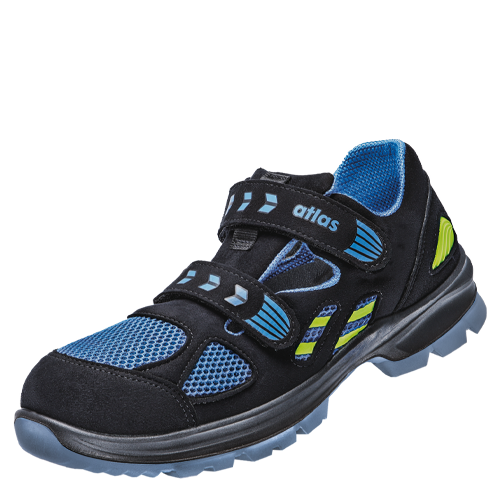
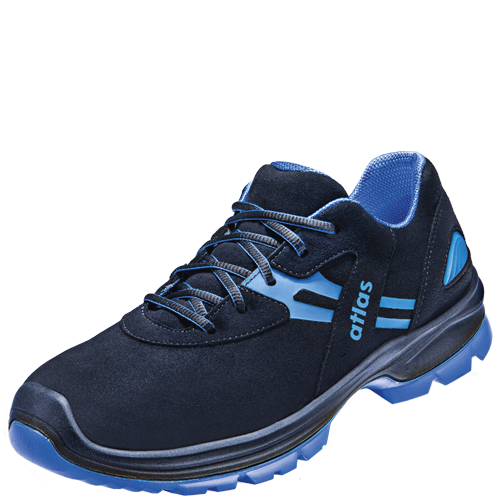
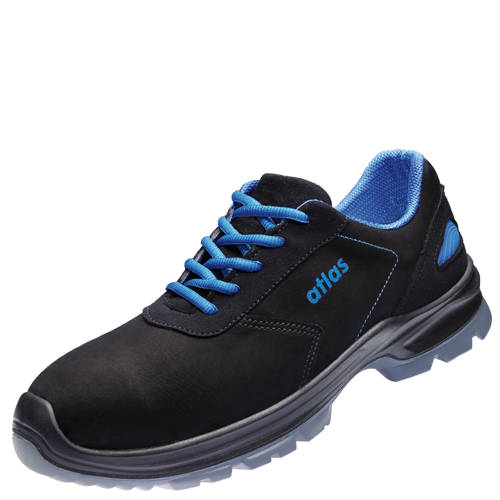
ATLAS’s specialised multi-width system ensures that there is a comfortable option available for every worker. All our safety shoes are available in standard width 10, whilst various models are offered in widths 12, 13 and 14. Not only do we offer safety footwear in various widths for all industries and working environments, but we also provide a special range for people with particularly large and wide feet.
A further 12 models:




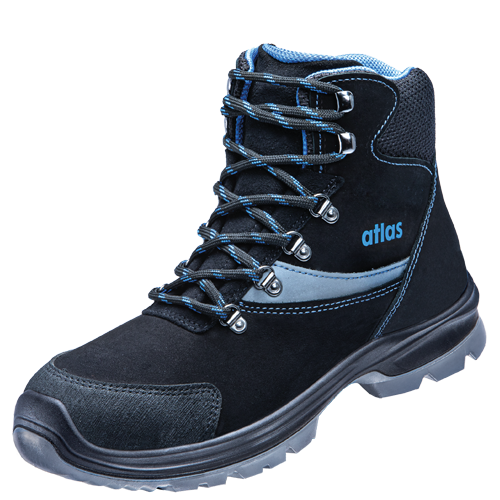


Introducing the Big Size range
The ATLAS BIG SIZE range is carefully crafted using a specially developed three-dimensional last to guarantee a flawless fit and noticeable pressure relief for exceptionally large feet. This specialised collection extends our range to include the rare shoe sizes 51, 52 and 53. This ensures that professional protection and comfort remain absolutely non-negotiable for you, regardless of your shoe size. Wearers can choose between the robust safety classes S1P and S3, which are fitted with toe caps, highly slip-resistant outsole systems and 100 per cent permanently breathable uppers made from high-tech mesh. Ultimately, this range delivers the uncompromising safety, outstanding grip and ergonomic support that every worker deserves.